We are flooded with images! Just open Instagram Stories and see for yourself. Honestly, how many times this week have you seen something cute, funny, or infuriating that you felt compelled to photograph? Perhaps you even uploaded it to the internet for "eternal safekeeping."
When I travel abroad and reach hyper-touristic sites, I know there’s no real reason for me to photograph the statue or the fountain. You can find infinite images of the Eiffel Tower, the Berlin Wall, the Colosseum in Rome, or the Sydney Opera House online, in gift shops, and in movies. Me taking a picture there won't make a bit of difference. I prefer to take in the atmosphere and move on to something authentic- something that will teach me something about the city, the world, and myself.
From this starting point, a question emerged: "Is it possible to reconstruct a 3D model of the Statue of Liberty using only media found online?" To me, as someone who doesn't work in 3D modeling but appreciates the craft, high-quality models are the vanguard of modern media. You can do so many unique things with them, and the "weight" of a good model can be far more significant than that of a simple photo.
At this stage, I had to define where the media mining would take place. I enlisted the help of two friends- Shaked Regev and Raz Manash. The idea was for each of us to mine from as many sources as possible: YouTube videos, Google Images, social media, Google Earth, Google Street View, and more.
Because I wanted to gather the largest mass of sources possible, it turned out that one of us was less "efficient" at collecting bulk files. In this case, it was me; I manually screenshotted Google Street View and contributed only 9 images. Meanwhile, with a few simple clicks, one of my friends managed to download a two-and-a-half-minute video file containing 3,500 frames. After converting the video into individual images using VLC Player, we had 3,509 photos to feed into Reality Scan. The software is designed to take images with high overlap and reconstruct the 3D model depicted within them.
After a long processing run, several issues emerged. I tried running it again and deleting unnecessary areas. The first discovery, which wasn't entirely surprising, was that the software easily reconstructed the front of the statue, but not the back. On one hand, this reveals a clear bias: most people photograph the statue from the front. On the other hand, it’s a bit ironic considering the back of the statue isn't particularly complex.
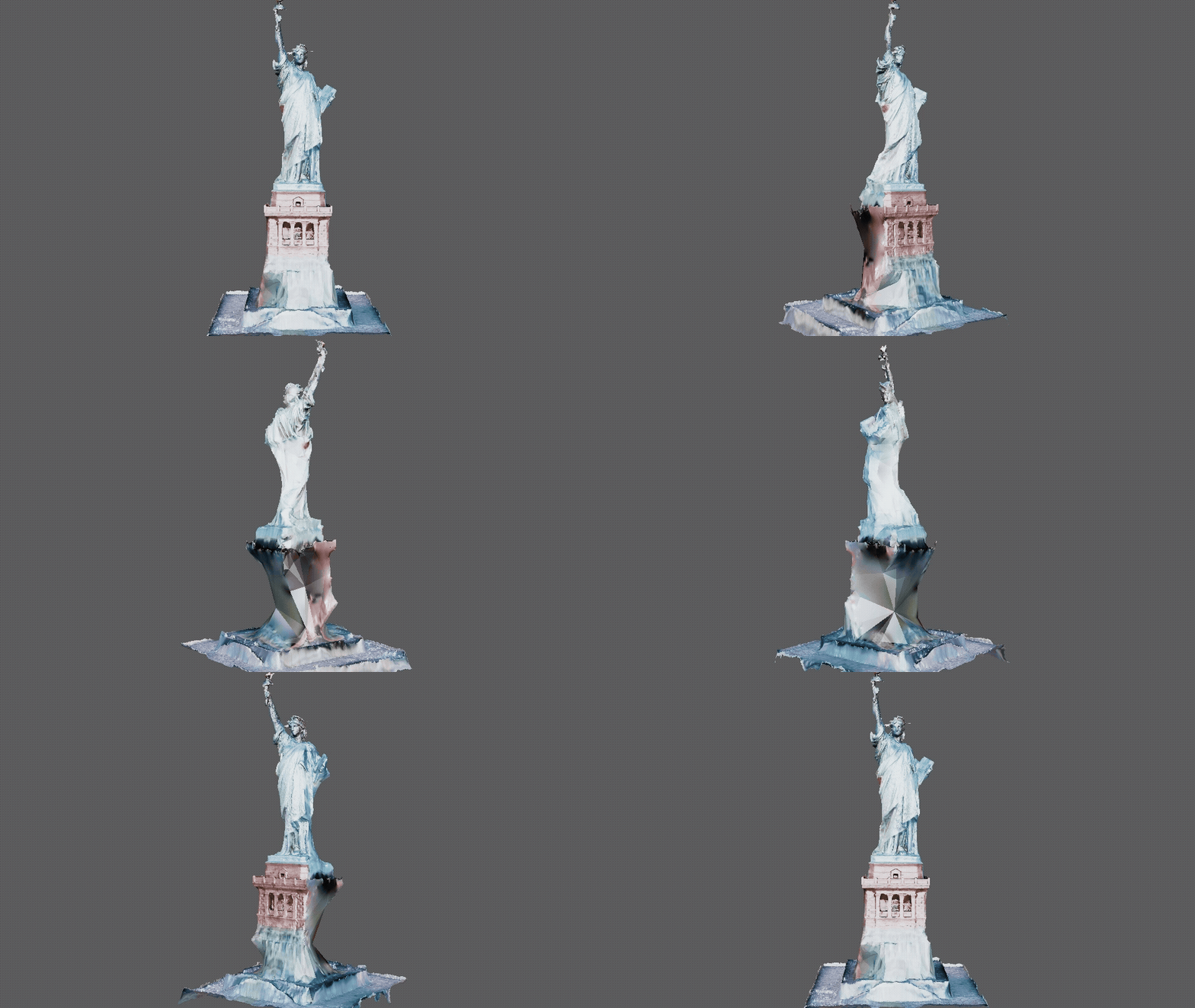
The Statue of Liberty 3D model, Based on 3500 images from video.
1.5M polygons. Made with Reality Scan
During the preparation for this experiment, I discovered I wasn't the first to have this idea. A 2009 study titled "Building Rome in a Day" did exactly what I was thinking of, but on a much larger scale. Using less sophisticated tools but significantly more labor, they collected about a million images from the web to digitally reconstruct parts of the city of Rome. They succeeded brilliantly.
In the era of Big Data, I’m certainly not the first to say that there are incredible things we can do with online information. What my team did here is just another small taste of how today, you can choose not to take a photo and still create media. And yes, AI certainly has a part to play in that:
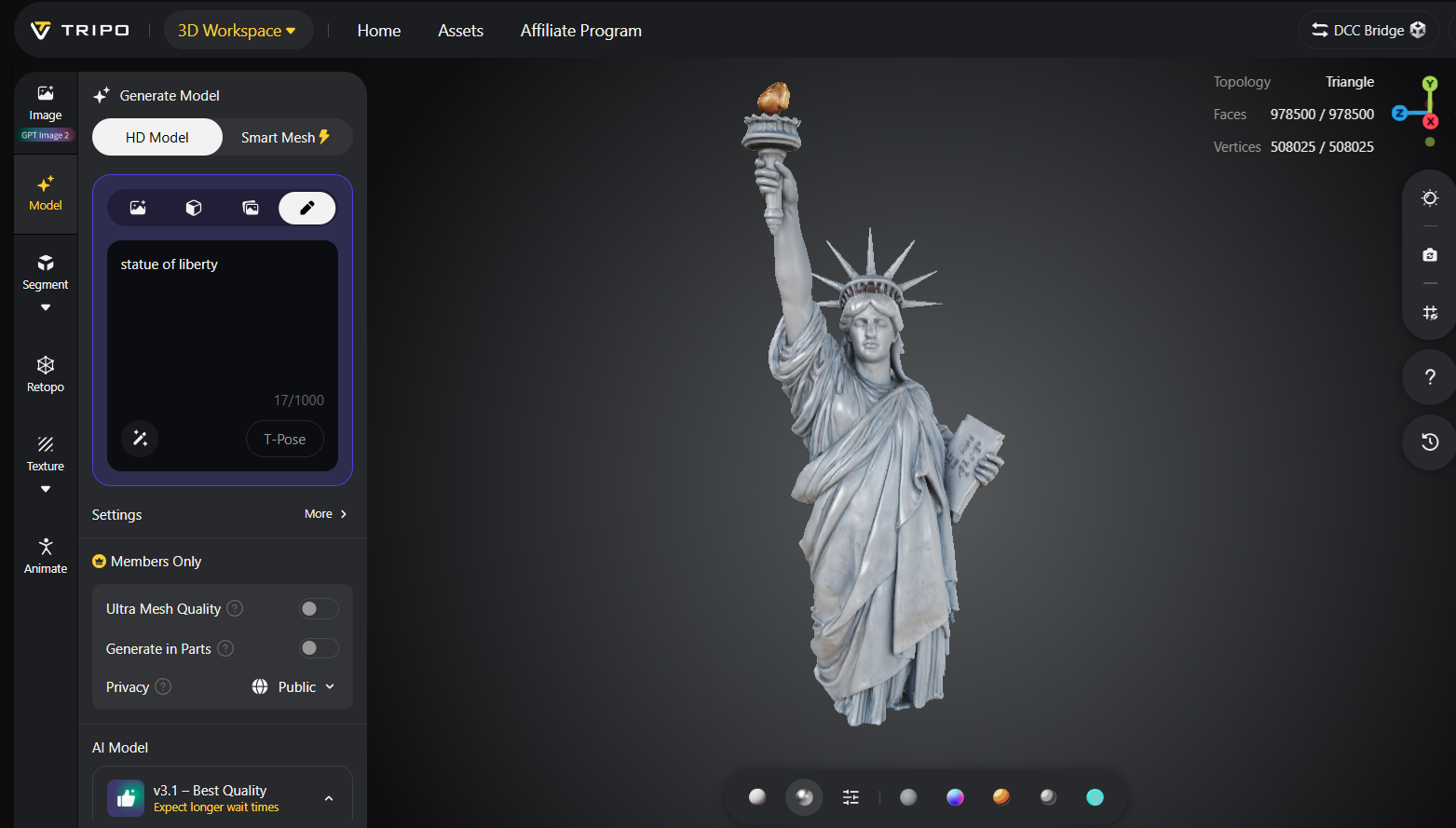
Tripo's "Text to Model" version of Statue of liberty.