Recently, I watched Now You See Me: Now You Don't. I had very few expectations for it, yet it really disappointed me. The plot was generic and felt like an unnecessary reunion that nobody actually wanted to be attend. Regarding criticism of this specific film, the less I write, the better.
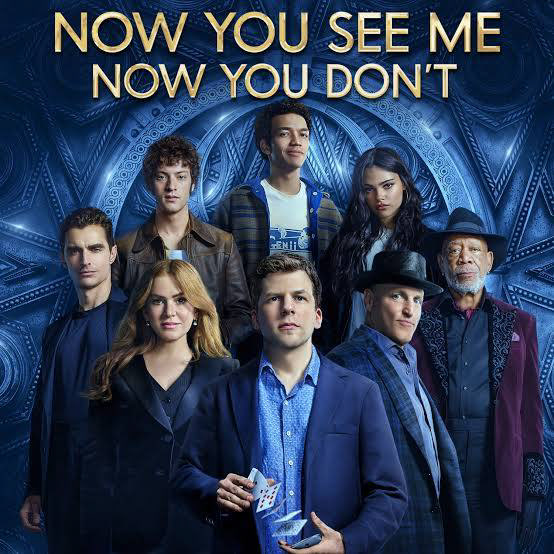
Yet, there was something that caught my attention- the source of each magic in the film; in the beginning, and sorry, SPOILERS ahead– we meet a group of young undiversified magicians who preform an event. They are pretending to be The Four Horsemen, the magicians' group from the previous films, tricking the audience on stage. On one trick of the performance, the Horsemen seem to transform into "a volunteer's" body. At the end of the event, their victim reveals that the characters on the stage were only projections.
So here is the magic without the plot- several bodies transform into one body. There's a gap in the ways the magic trick was made. For the diegetic audience, the visitors in the performance, the trick was made by projectors, without any involvement of the Horsemen. On the other hand, for the audience in the cinema theatre, it was made with lots of VFX and editing. We are not shocked how they represented these characters so smoothly, we are confused by the discovery of the trick, that a large audience couldn't tell the difference. It's secondhand magic.
In many other films about magic, it is all about VFX and editing. From Harry Potter's spells or moving portraits, to The Sorcerer's Apprentice. Learning to make a thunderbolt is one of the basic things a visual effect editor may do in the first few weeks. It's very handy for other kinds of VFX. Sometimes it even comes as a prefab to speed up the process.
Another way to make us excited is to pose a riddle and solve it later. The common way is by hiding information from us and then, while solving it, providing us with new information. Guy Ritchie's Sherlock Holmes from 2009 does it many times – Sherlock miraculously sees the ink on Mary's cheek, knows the bumpers and the smells of the Streets of London and how to concoct potions. In most cases, we don't even get the clues that he has, so if the film is stopped at that point, we can't solve the mysteries alone in our homes. There is a Built-in gap between the information he has and we lack of. We see that in many other mystery films like Knives Out and The Prestige. By the way, when reading Sherlock Holmes stories written by Arthur Conan Doyle, we have all the information that we need, but it is hard to solve the case by ourselves.
Some other films let us solve the riddle at home. They ask us to keep searching for the solution. Here, the gap is between the information the film provides, mostly driven by the narrative, and the information another source can provide (like a website). That's an opportunity for transmedia storytelling to emerge; it can start with a film, continue with a website, and finish with an event. For example, The Blair Witch Project, made the audience think that the actors of the film were really lost.
After seeing Now You See Me: Now You Don't, I remembered the opening scene of the trilogy. The first magic made me appreciate the whole film, and as my generation says, it lived rent-free in my mind for more than a decade. Here it is:
In this scene, Jay Atlas shows cards from a deck for a very short period. He asks the lady in front of him to pick a card from the deck that she saw. Using her, he is asking us, the audience, to pick a card from the deck. Then he shows the cards again. We have a card in mind- the 7 of diamond. Atlas shows some cards and asks her & us if the card is there, which isn't. He points at the building next to them and there it is, in bright shining lights- the 7 of diamond.
Let's break it down! The scene shows us several cards (e.g. 7♦, K♦, 4♠…) but eventually the film knows what card we're going to pick- 7♦. At the end, the 7♦ is on the building, surprising all of us. It means that we all chose that exact card unanimously. The film just began so it couldn’t implant the card in memories of us (like they do later in the plot to one character). There are no sensors in the theatre, monitoring our collective eye tracking, and tailoring the end to our behaviors.
Pause- on my first year of university, a student created an interactive film that uses Tobii eye tracking camera. The narrative was affected by the objects that the viewer looks at. It is a pre-recorded film, meaning that there were a definitive number of endings, yet we don't experience them all (see: FMV). We talked after a test, and he told me that the film can predict whether someone is hetro/homosexual, prefers wine or weed and such. It was very ambitious of him to declare that, but I knew what he meant- by looking at an object, we desire it and a computer can calculate which segment to show next. It's a simple algorithm of A/B that we have in mind, very easy to implement on game engines. As far as I know, this technology has not been invented yet to mass consumption of cinema.
Having said that, there must be a reason for the magic to happen. I got a video file of the scene and I checked frame-by-frame of the 2 shots of the trick. I analyzed the cards that appeared on the screen. Here's a table showing that:
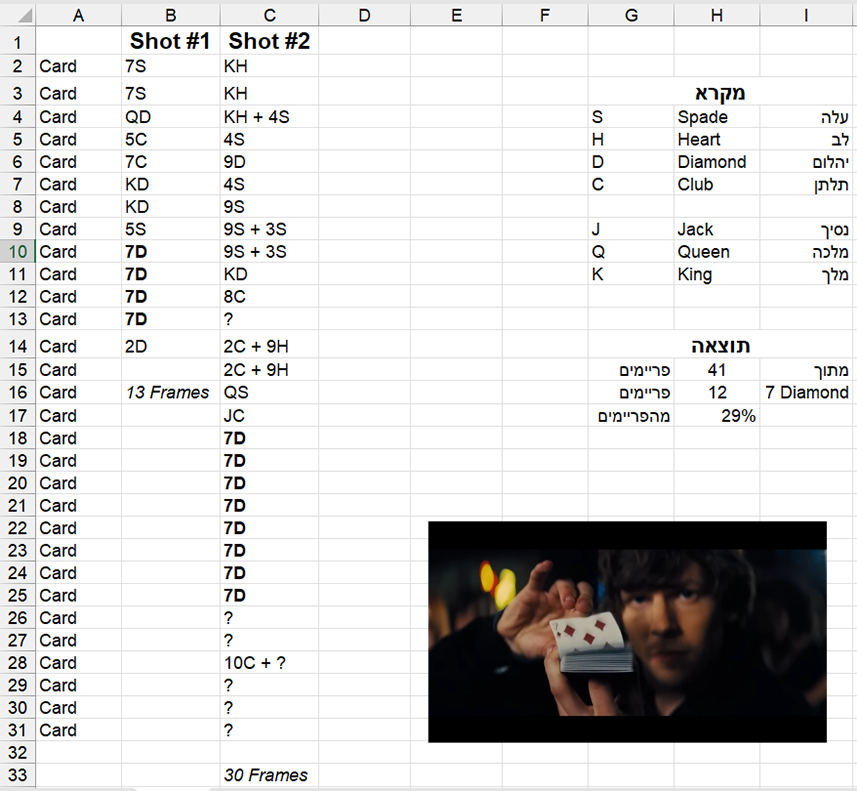
When we watch the scene for the first time, we don't notice it, but the 7♦ is there in 29% of the frames, more than any other of the cards. In total, it's only 12 frames out of 41. Considering that the whole film is 170,000 frames, 12 frames is not much. These 12 frames make the difference, and they are enough to implant that card (or thought, some might say) in our mind. We see commercial logos of actual companies in films for way longer than 12 frames. It might be enough to make us think that a film is artistic while advertising that company.
The magic here lies on cognitive realization of the human mind; we are exposed to a variety of images that fucuses our minds to think what they want us to think. Making 7♦ appear 70% of the time would make us wonder if the whole deck is just that card, while showing it 3% of the time, just 1.5 times more than the normal 1.9% of the deck, wouldn't do the trick. Someone probably thought about the trick and tested it many times before putting it in the script. The field of cognitive film theories is the key to creating this kind of film.
In the Now You See Me: Now You Don't (2025), there is a similar "pick a card" trick. 5 cards are in front of us. We must pick one. A short moment after, that card appears somewhere else. For me, they pulled it. While watching it, I was fascinated and asked the friend next to me if they had got it right for him as well. He nodded. I wonder what was the reason they were right, and why only for me; is it a simple guess, the place in the frame or subconscious thing? There must be a reason and will look for it when the film will be available elsewhere.
The Horsemen say, "the closer you look, the less you see". I say, "the slower you observe, the more you discover"